+38 044 383-03-46
 Cost calculation
A fireplace is a wonderful way to create a cosy atmosphere at home and, in some cases, an excellent source of heating that can be especially helpful during blackouts and freezing winter weather.
However, we are increasingly hearing questions from building services designers, architects, interior designers and homeowners themselves: “Can a recuperator be installed near a fireplace?”, “Could this create a risk of backdraught?”, “Is this a safe solution for a home?”, “How should ventilation be designed if a client is planning to install a fireplace?”.
In this article, we will answer your questions. The short answer is that a recuperator can be installed in the same room as a fireplace, but there are several important factors to consider.
The type of fireplace, the combustion air supply, the chimney design, the airtightness of the building and the operation of other extract systems are particularly important. Modern flats and houses are becoming more energy-efficient and airtight: high-quality windows, insulation and measures to minimise uncontrolled heat loss significantly reduce the natural supply of air, which is needed both for comfortable living and for the fireplace to function.
Why does a fireplace need a dedicated air supply?
The reason is simple: combustion requires oxygen. If a fireplace has no dedicated air supply duct, it draws air directly from the room, and this air must be continuously replaced by air from outside.
Our grandparents lived in homes with stoves, where ventilation systems were not a necessity because fresh air entered naturally through gaps in windows, doors, roofing and elsewhere.
Today, as airtight construction methods become increasingly common, fresh air no longer enters in this way, making ventilation essential.
If air is extracted from a room faster than it is supplied, negative pressure may develop. Under certain conditions, this can affect chimney performance and create a risk of backdraught.
The U.S. Department of Energy’s Building Science Education programme emphasises that a fireplace must have an adequate supply of combustion air. For a natural-draught fireplace, for example, the U.S. Department of Energy recommends providing a dedicated duct that supplies outdoor air directly to the firebox.
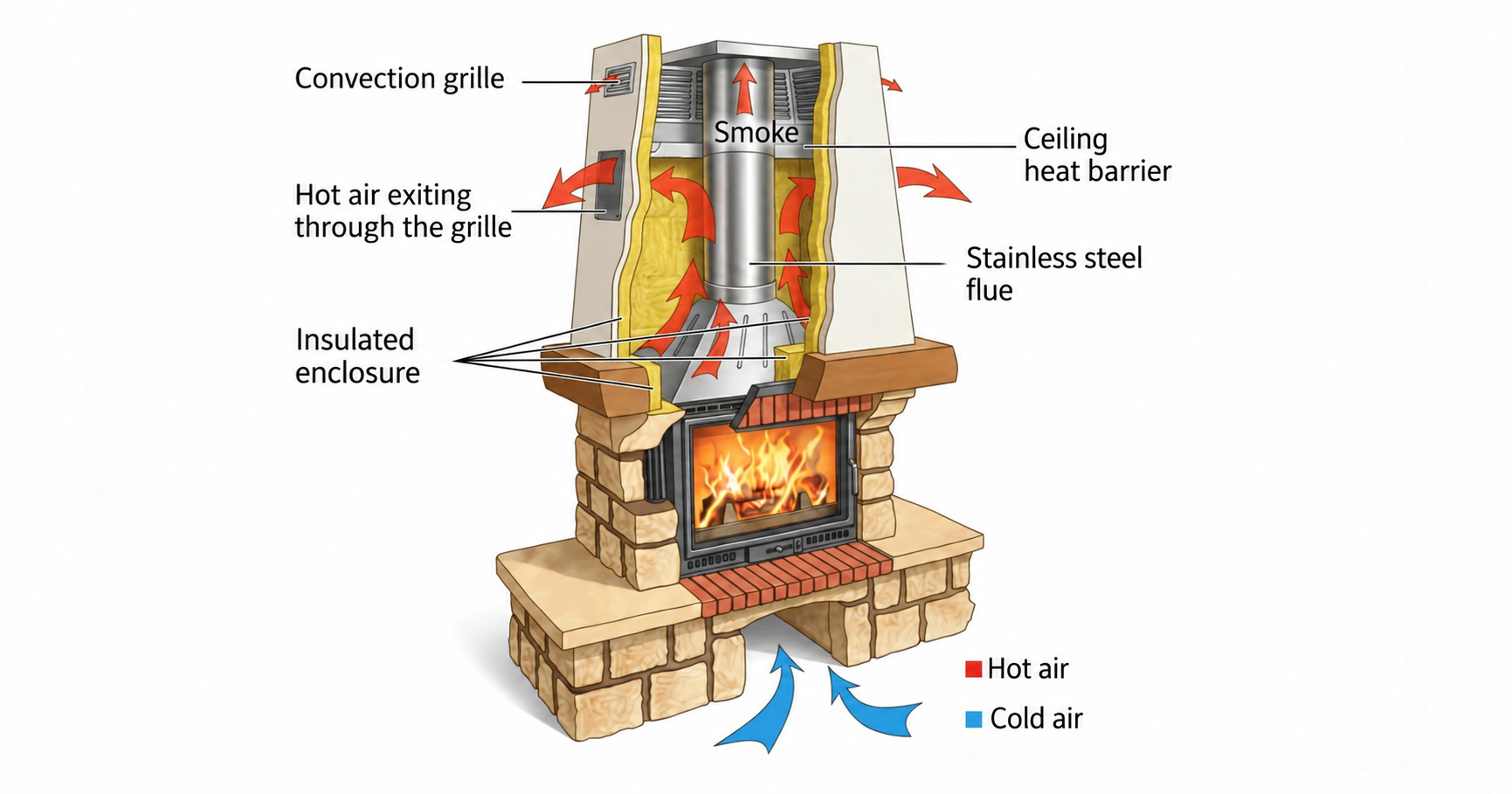
Air for fireplace operation is drawn from the room.
Does the type of fireplace matter?
Absolutely. Ventilation has the least impact on fireplace operation when the fireplace has an airtight, closed firebox supplied with combustion air directly from outside through a dedicated duct. However, its compatibility with mechanical ventilation must be checked against the fireplace manufacturer’s documentation and the chimney requirements.
If you have an open fireplace without a dedicated air intake, the room’s ventilation must be designed carefully and correctly. The assessment must account not only for ventilation capacity but also for chimney performance, the air supply, building airtightness and the simultaneous operation of other extract appliances.
What do Ukrainian building regulations say?
The current DBN V.2.2-15:2019 “Residential Buildings. Basic Provisions” explicitly addresses the presence of appliances that use room air for combustion.
The notes accompanying the air exchange requirements state that the specified minimum airflow rates and air change rates apply to rooms without appliances that use room air for combustion, such as a fireplace, boiler or gas water heater.
For rooms containing such appliances, the adequacy of the specified air exchange must be checked additionally in accordance with DSTU B EN 15242.
This means that, when installing ventilation in a room with a fireplace, simply applying the minimum permitted air exchange values without accounting for fireplace operation is insufficient.
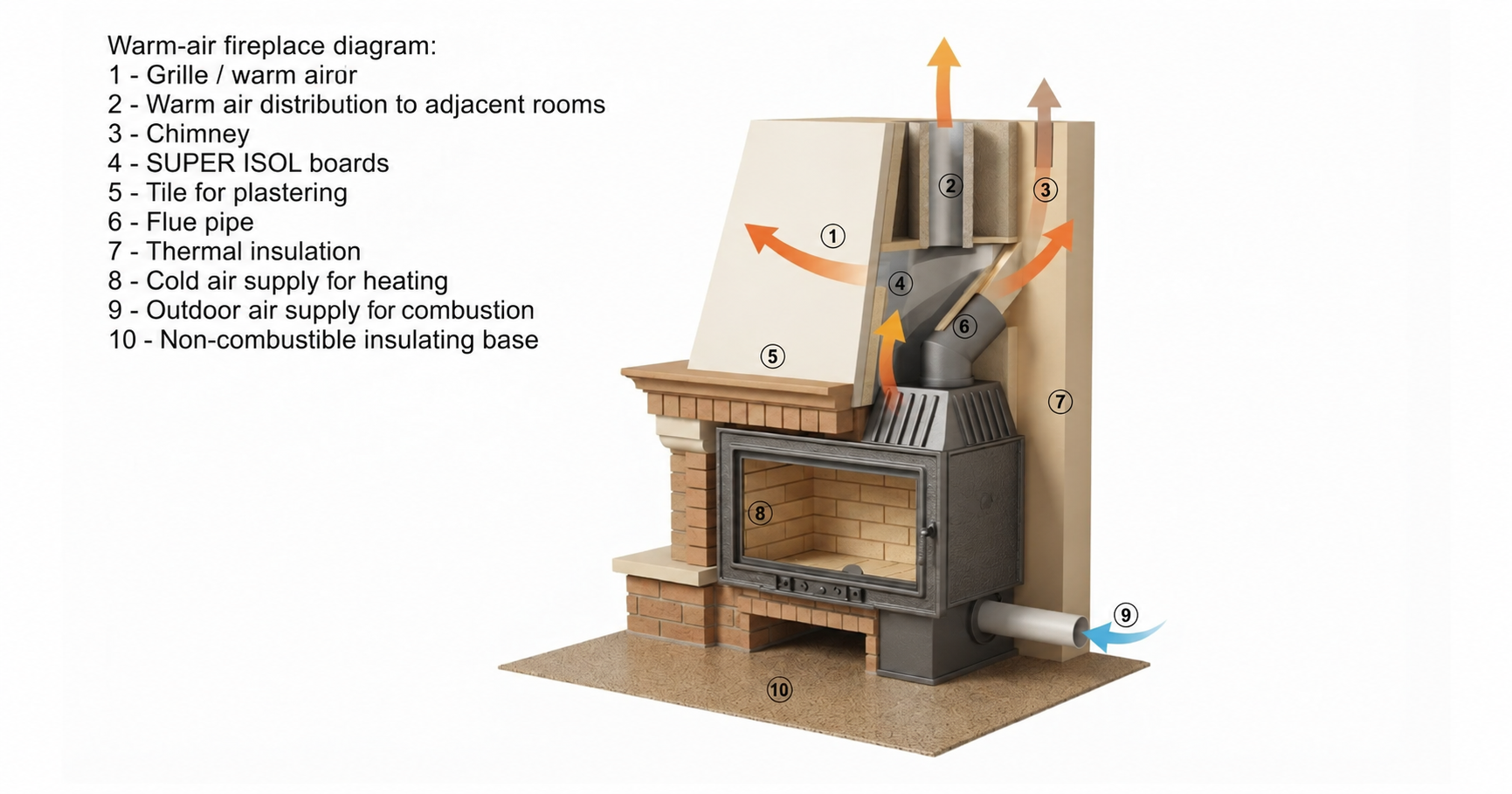
Air enters through a dedicated air supply duct (No. 9).
What about the recuperator?
A recuperator provides full room ventilation by simultaneously extracting stale air and replacing it with fresh air, while retaining up to 98% of the heat.
As with any ventilation appliance, installing a recuperator incorrectly increases the risk of backdraught.
How far from a fireplace can a recuperator be installed?
There is no universal regulation specifying a particular distance in metres between a recuperator’s indoor unit and a fireplace.
The following factors must be considered:
- the type of fireplace;
- whether the firebox is open or closed;
- the fireplace manufacturer’s recommendations;
- the temperature of its surfaces;
- the position of the chimney;
- airflow directions;
- the position of the outdoor air intake;
- other ventilation equipment in the room.
However, Ukrainian regulations do specify another important distance.
According to Clause 7.3.3 of DBN V.2.5-67:2013 “Heating, Ventilation and Air Conditioning”, an outdoor air intake must not be located closer than 8 m horizontally from chimney tops or a number of other potential sources of pollution.
For an architect or building services designer, it is therefore important to consider not only the position of the recuperator’s indoor section but also exactly where its outdoor air intake will be positioned on the façade in relation to the chimney.
If your flat or house has an open fireplace, the recuperator must be positioned so that its air stream does not interfere with firebox operation, the equipment is not exposed to elevated temperatures, and the outdoor air intake is protected against flue gas ingress.
For example, suppose your unit is operating at a 3/3 speed setting. The volume of incoming air equals the volume of extracted air. For everyday domestic use, this is an ideal arrangement. However, as we have already established, an open firebox draws oxygen from the room itself. As a result, the total amount of air leaving the room begins to exceed the incoming supply, creating a risk of backdraught.
While the fireplace is in use, we recommend increasing the recuperator’s supply fan speed. In some cases, a setting with a higher supply airflow than extract airflow can reduce negative pressure in the room. However, there is no universal setting, such as 3/1, that guarantees protection against backdraught. Settings must be determined with regard to actual airflow rates, the characteristics of the fireplace and chimney, and the operation of other extract systems. For an open fireplace, the primary solution should be a dedicated combustion air supply; an imbalance in the recuperator’s airflow should be considered only as a supplementary measure.
*This caution applies only to open fireplaces without a dedicated air supply to the firebox. Electric fireplaces have no special combustion air requirements. An airtight, closed firebox with a dedicated outdoor air intake interacts much less with ventilation, but the requirements of the fireplace, chimney and ventilation equipment manufacturers must still be followed.
The best time to plan ventilation
Ideally, the ventilation system and fireplace should be planned at the house design stage. This allows a dedicated outdoor air supply duct to the firebox to be included in advance, air exchange to be calculated correctly, and the optimal installation area for the equipment to be identified. However, an existing fireplace, even an open one, should by no means be a reason to give up a comfortable indoor environment and heat retention at home.
In rooms with an existing fireplace, decentralised ventilation can be used after assessing the type of firebox, the combustion air supply, the chimney characteristics and the operation of other extract systems. A supply airflow greater than the extract airflow may reduce negative pressure, but it does not replace a dedicated combustion air duct or a draught check.
PRANA recuperators can be installed at any stage of construction without damaging interior finishes, using diamond drilling technology. Our highly qualified specialists will help you choose an installation location, drill the opening, connect the system and configure its settings. At the customer’s request, PRANA also offers the option of painting the outdoor and indoor covers in any of 140 RAL colours, allowing the recuperator not only to provide air exchange but also to become part of the room’s interior design.
Questions and answers: fireplaces and recuperators – what you should know
1. Can a recuperator be installed in the same room as a fireplace?
Yes, it can. The key is to account for the type of fireplace (closed or open firebox), the combustion air supply, the chimney design, building airtightness and the operating modes of other extract systems in the room.
2. What is the difference between a closed-firebox and an open-firebox fireplace in terms of ventilation?
A fireplace with a closed firebox is sealed by a door, and combustion air is supplied through a separate pipe from outside. It therefore does not consume oxygen from the room, so there is no risk of backdraught. An open fireplace draws air directly from the room, so its ventilation must be designed with particular care.
3. What do Ukrainian building regulations say about ventilation in rooms with a fireplace?
According to DBN V.2.2-15:2019, the minimum air exchange requirements apply only to rooms without appliances that use room air for combustion (a fireplace, boiler or gas water heater). Where such appliances are present, the adequacy of air exchange must also be checked in accordance with DSTU B EN 15242.
4. How far from a fireplace can a recuperator be installed?
There is no specific regulatory distance between the recuperator’s indoor unit and a fireplace. It depends on the type of firebox, the manufacturer’s recommendations, surface temperatures, and the positions of the chimney and air intake. However, DBN V.2.5-67:2013 (Clause 7.3.3) requires the outdoor air intake to be positioned at least 8 m horizontally from chimney tops.
5. How should a recuperator be configured while an open fireplace is in use to avoid backdraught?
In some cases, a setting with a higher supply airflow than extract airflow can reduce negative pressure in the room. However, there is no universal setting, such as 3/1, that guarantees protection against backdraught. Settings must be determined with regard to actual airflow rates, the characteristics of the fireplace and chimney, and the operation of other extract systems. For an open fireplace, the primary solution should be a dedicated combustion air supply; an imbalance in the recuperator’s airflow should be considered only as a supplementary measure.