
 +38 044 383-03-46
 Cost calculation
Decided to insulate the facade of the house? Have you already chosen the material – styrofoam or polystyrene foam? Calculated the necessary thickness and the quantity of thermal plates and additional materials? Found a building brigade? Or have you already insulated the facade and are counting the savings on heating? Spontaneous Ukrainian campaign of home insulation started so loudly and quickly that the average consumer has not even had time to realize how thermal insulation will affect the condition and microclimate of his house. And according to expert predictions, the effect can be not only positive.
Insulation of facades is essentially turning the house into a kind of thermos, which will retain more heat by significantly reducing the natural air exchange of the walls. As a result of such measures, the homeowner can save on heating. And face a number of problems: an increase in humidity level of the premises, reducing the required air exchange, moving the dew point to the space between the wall and insulation (and as a consequence – the appearance of fungi).
The most popular thermo materials for such insulation are usually poorly vapor permeable. For example, for popular expanded polystyrene foam with a density of 150 kg/m3 the vapour-permeability coefficient is 0.05, for PVC foam with a density of 125 kg/m3 – 0.23, and for mineral wool with a density of 100 kg/m3 – 0.56, for reinforced concrete – 0.6. This means that moisture in the form of condensate passes through reinforced concrete better than mineral wool or foam. The situation is complicated by the presence on the Ukrainian construction market of cheap thermo materials, the quality of which does not meet modern standards.
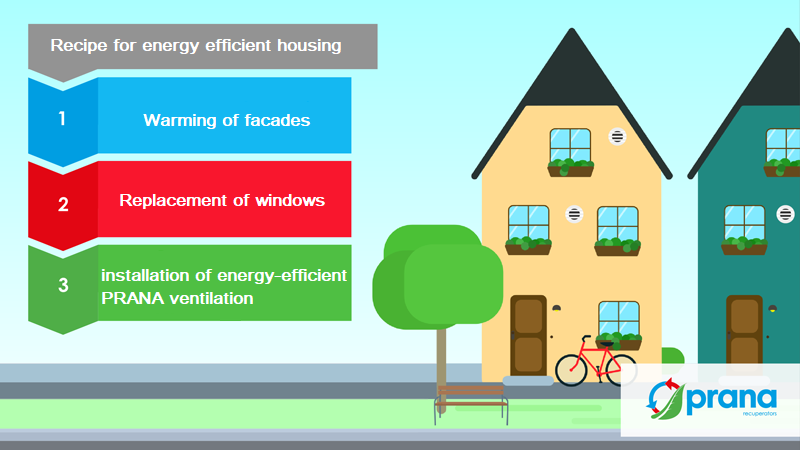
Therefore, it is necessary to insulate the facade along with the insertion of effective ventilation. This approach allows to compensate for the excessive humidity in the premises and to balance the microclimate as a whole. A quick and affordable solution is to install a supply and exhaust ventilation system – a recuperator. This device creates a proper constant circulation of air in the house: the inflow of fresh and exhaust air is carried out inside one ventilating unit without mixing. The exhaust air is often more humid than the tidal air. This is due to a number of factors: lack of heat balance, poor ventilation, flooded basement. For rooms with many people (offices, schools, kindergartens) the reason can be the fact that while breathing people emit moisture – up to 1.2 liters per day per person. PRANA recuperators effectively remove waste humid air, filling the room with fresh supplied air. The efficiency of the recuperators reaches 92%, which guarantees the preservation of heat in the house during heating and cool air in summer.