
 Cost calculation
Industrial models of PRANA recuperators allow you to organize centralized ventilation in commercial premises of various types. Ventilation systems are available in three versions. Each of them requires a certain method of installation, so you can choose a solution for your business.


More often, PRANA industrial ventilation systems are used in:


System control
The system can be controlled in one of three possible ways:
- by means of the remote control;
- by means of a mobile application;
- by means of the control unit.

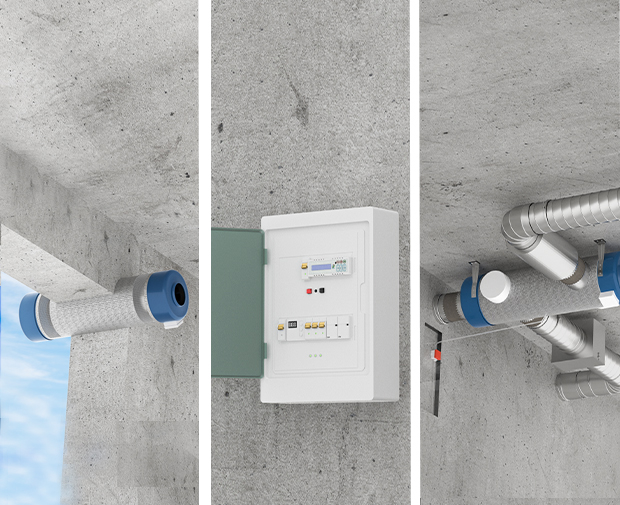
Variants of the system implementation
The type of industrial system determines the subsequent stages of installation:
- Walled. Mounted in the wall that interfaces with the street. Require drilling of the borehole diameter of 350 mm. Can be installed without wires and other components. Intake of external air and exhaust air is carried out directly on the system, as well as the flow and intake in the room .
- Internal. Used to organize a centralized ventilation system. Mounted horizontally evenly under the ceiling or on a stable wall. The name of the outlets for the air intake and outflow of air, near the premises – for the intake and inflow.
- Combined. As well as walled, these systems are mounted in an installation hole in the wall under the cut of 2-3 degrees. External air intake and exhaust is carried out directly on the system body, the inflow and intake in the room – by means of wires and grilles.

Combined systems
Such systems are assembled analogously to the wall systems. It is installed in a pre-drilled hole in the wall at least 350 mm in diameter. The system is equipped with a supply and exhaust grille on the street side, and connectors for connecting the wires on the inside.
- Before ordering we need to determine the thickness of the wall in which to install the system.
- The minimum thickness of the wall – 330 mm.
- The distance between the air intake grids – at least 350 mm.
- When a heater is installed, a length of supply air duct needs to be provided additionally.

Wall systems
Systems are installed in the wall which borders with the street. A hole diameter of 350 mm is drilled, which is inserted into the working module at a slope of 2-3 ° to the side of the street. The housing (without taking into account the air intake grille) must protrude from the bottom beyond the walls by at least 1-2 centimeters.
- The minimum distance between the air intake grilles is 350 mm.
- The minimum thickness of the wall – 330 mm.
- When a duct heater is installed on the supply air duct near the premises, a duct section is additionally provided.

Interior installation systems
The operating module is mounted under the ceiling or on the wall by means of fixing elements. It is recommended to do so in the technical rooms. For the flowing air in and polluted air out we install the wall elements on the facade of the building. These are connected to the system by an electrical conduit. The distance between outdoor grilles is defined by state regulations.
Drainage of condensate is carried out in the existing sewer through the pipe diameter of 10 mm. It is located at the bottom of the unit. The system itself is mounted horizontally, without any pressure.
It is necessary to provide access to the components of the system to ensure further serviceability. If the components are stored in the plinth, the revision doors are installed.
General installation rules
Protection against vibrations
Ventilation systems PRANA 340S should be connected to the air inlets. Vibropolymer inserts are used when connecting the air lines.

Cleanliness of the heat exchanger
Filter boxes prevent coil blockage. These are installed on the supply air ducts. Installation on intake air pipelines is also possible if required.

Condensate drainage
In installations of wall and combined construction the condensate is drained by natural means, via an air intake. When installing the system in the premises with temperatures below 0 ° C, insulation or heating of the condensate drainage system required.

Freeze protection
Ventilation systems of walled and combined installation are completed with heating elements, “Winter mode” and «Mini-warm» functions.

Maintaining air pressure
To reduce aerodynamic losses at the inputs and outputs of the recuperator, the direct section of the air inlet should be not less than 1 m. The inlets, thrusters and other elements of the network are installed after it.

Noise reduction
Centralized ventilation systems are recommended to be supplemented with sound attenuators.

Air heating
For additional heating of supply air in the cold periods of the year (at a temperature up to -30 degrees) the ventilation system is supplemented with a heating heater.